

I recently put up several posts on LinkedIn exploring the challenges of leading a roadmap that is both innovative and profitable. Let me consolidate them here. First is a longer form video, then a few text posts.
5 MISTAKES IN ROADMAP MANAGEMENT
I was testing to see if a longer form video would play on LinkedIn, as the trend on YouTube.
DROWNING IN IDEAS
If I were a CEO or executive leader, the question that would keep me up at night is: “Do we have the BEST product ideas on our roadmap? Are we developing ideas that will lead to profitable cashflow?”
I’ve unfortunately seen companies of all sizes developing products from roadmaps that were really more like dart boards with random ideas than competent plans for driving future growth.
One of the biggest problems I’ve seen in innovation is that organizations confuse having ideas with being innovative. AI makes that problem much worse. Anyone on a team can now “research” a market, generate concepts, create visuals and produce something that feels close to a finished product. That’s incredibly powerful, but did they curate those ideas, vet them and test the best candidates with real customers? Did they identify a clear customer “hook” that can lead to great marketing and give the sales team something compelling to talk about? How did your team decide what is actually worth creating? Or did someone get excited about an idea in the shower and run ahead to launch it without doing their homework?
My thesis in my “Anyone Can Innovate” keynote was that innovation isn’t about having a genius in the room. It’s a process for gathering uncertain ideas and systematically derisking them: finding a meaningful opportunity before your customers even recognize it, understanding the customer and problem, exploring alternatives, testing assumptions, prototyping cheaply, learning, killing bad ideas, developing promising ones, building the business case and getting an organization aligned enough to invest. AI can accelerate almost every step, but it doesn’t replace that process. In fact, it makes the process more important.
“Wouldn’t this be cool?” should be quickly followed by “Would it be profitable?” and then “Would it be the most profitable opportunity we have?” Answering those questions requires people who see across disciplines rather than stay inside one professional silo: technology, design, product, manufacturing, marketing, sales. Testing what should be developed, why someone will want it, how we can build it, and ultimately how it makes money.
AI is let’s organizations drown themselves with ideas. The companies that win will be the ones that get better at deciding which ideas deserve to become products, experiences and new segments. That’s the work I’m interested in.
NEVER ASK YOUR CUSTOMERS WHAT THEY WANT
…unless you prompt them first with a set of creative product ideas that catalyze them to think differently.
Steve Jobs said it best: “A lot of times, people don’t know what they want until you show it to them.”
Of course you listen to your customers; Jobs was not saying to ignore them.
But there is a huge difference in having a dialogue with a customer versus dumbly asking “what do they want” and acting like an order-taker instead of an innovation leader.
Being an order-taker means you’re hunting for revenue. Being an innovation leader means you’re hunting for profit.
Some thoughts from my own experience in product management in lighting and A/V systems:
1. Your customers are architects, lighting designers, A/V integrators, attraction designers, etc. THEY ARE NOT PRODUCT DEVELOPMENT TEAMS. They don’t have any background in engineering, manufacturing, supply chain, etc. They have little-to-no idea how much effort goes into producing something. They don’t care if what they want is profitable for you or not.
2. That being said, some customers are indeed polymath designers who can project ahead into the future and give you competent feedback on new ideas you put in front of them. These types of customers are gold. Treat them like VIPs – they are insanely valuable to you.
3. Make every idea visible and tangible. Don’t ask them abstract concepts; show them sketches, renderings, videos, and hand them models to hold and touch. Showing a customer even a crude sketch or handing them an ugly model provokes a deeper line of thinking in their minds. In fact, showing them rough work-in-progress rather than a polished, finished presentation often frees their minds to engage and give better feedback.
4. Never just show one idea and ask “do you like it or not?” A person’s ego demands they look smart and criticize the idea. Always show them at least 3 ideas, which forces them to do a more meaningful pro’s and con’s comparison. You get much better feedback that way and can quickly gauge relative potential success.
Do you feel like you’re trapped in commodity hell? Let’s talk and I can give you ideas on how to ignite your product roadmap.
A.I. IN PRODUCT MARKETING
Product marketing is being radically changed by AI. It is interesting to think about the impacts at all levels of the sales process.
I still believe this is one of the best slides I ever made, as I continue to be shocked at how many company leaders don’t understand the difference between the purposes of marketing, product marketing and sales comms. They kind of lump them all together in one undifferentiated mass in their minds.
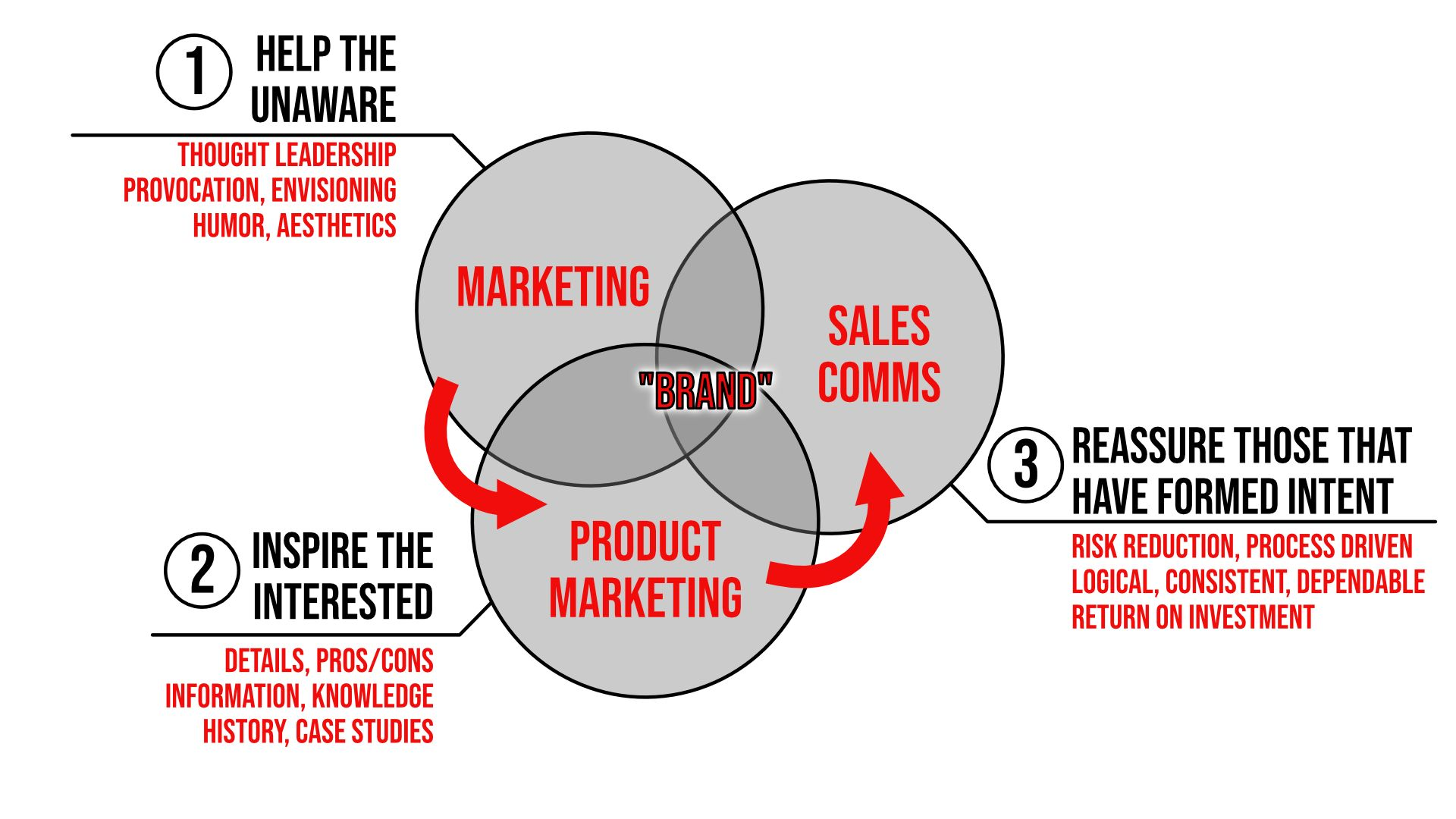
Now, AI is changing both the customer search experience and the way content is produced, which completely upends the traditional tactics used by product marketing managers.
My initial observations:
1. No one reads anymore. I’ve said this already for two decades, especially when thinking about dreadful B2B content that just shouts tone deaf at it’s customers. Now, AI agents will do all the parsing for those customers, so content needs to be accurately detailed and hyper expanded for machine reading. No customer will suffer your dreadful B2B copywriting anymore.
2. When you finally reach a real human, you better have hyper-customized video content made just for them, with compelling storytelling, gorgeous visuals and snappy editing. Yet still, most companies can’t even begin to understand how to produce –any– video content, much more thousands of customized pieces. And OMFG what are you doing still emailing prospects attached PDFs like it was 2005?
3. Stop chasing perfection. Perfection is a mirage always somewhere in the distance. I’ve repeatedly seen well-intentioned company owners completely cripple their product marketing teams chasing their visions of perfection, rather than shipping fast and iterating faster. Now AI makes that “perfection” time penalty even more deadly, as AI rewards good-enough as long as it is immediate and readily available.
Maybe its because I myself was a specifier for the early part of my career, but overall, I preach a core theme that transcends tech trends:
If you don’t respect your prospect’s time as the single most valuable commodity of their existance, you are letting your B2B ego produce dreadful B2B shlock that is killing sales prospects.

