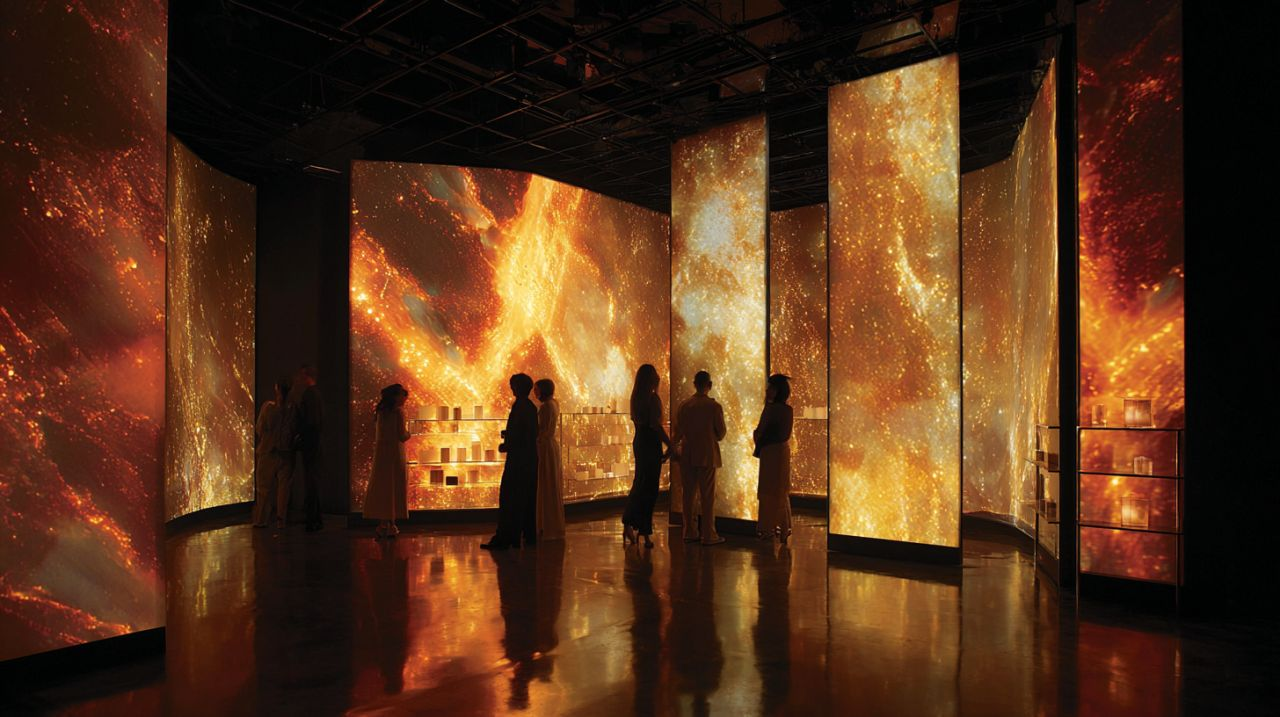
We are entering an era where digital surfaces will continue to expand rapidly in architectural placemaking. I’ve spoken at length about treating our physical places as portals to the digital world, as immersive digital experiences, and the many secondary innovations that can then occur across applications including retail, healthcare and hospitality.
A key driver of this growth will be reducing the cost of digital media, and a key driver of reducing the cost of digital media is switching from premade “canned” media to live “generative” media. Generative media is computed live, with a given set of variables, effects, media clips, data inputs and sensor inputs, creating continually emergent environments.
So spaces with strong digital integrations will continually emerge over time – and architects will have to embrace “designing emergence”.
If traditional architectural design is like scratching a line in the dirt to show where the bricks go, then designing an emergent space is like planting a seed in that dirt instead. It will grow into something beautiful — and you can prune it and shape it as it grows — you just will never know exactly what the specific shape will look like in the end.
It sounds like a radical shift for control-freak black turtle-neck wearing designers, but I see it as a continuation of the advances introduced through parametric design tools like Grasshopper + Rhino and the generation of architects who grew up comfortably snapping outputs to inputs in Grasshopper will be comfortable establishing parametric design concepts for the digital envelopes surrounding us. It will be natural for them to define the goals, parameters and constraints upfront, and they will intuitively understand how these can be amplified through AI/ML feedback loops that carry design intent forward throughout the life of a space.
And then they need to press go, to turn their digital portal loose on the built world, to trust they picked the right parameters for their design to evolve over time. That will be like jumping off a cliff for most project teams who can’t conceive of trusting their own systems like that.
But designing emergence will become unavoidable for architects who want to discuss meaningful, measurable ROI with their clients. I’ll save that for the next post…
*** HEY YOU! *** If you’ve read this far, I’m currently looking for a new creative director role to help retail, hospitality or healthcare clients embrace these new digital placemaking concepts. Know of anyone hiring? Let me know!