
As a lighting designer for many years, I came to the fervent belief that ASHRAE 90.1 needs to be overhauled to focus on power consumption, not installed load. And that was well over a decade ago. That has only become more acute than ever with the move towards true net-zero energy buildings.
The entire ASHRAE 90.1 code should be tossed in favor of something as simple as this:
- CARBON DIOXIDE EMISSIONS FROM YOUR BUILDING ARE ILLEGAL
- YOUR [HEALTHCARE, OFFICE, RETAIL, etc.] BUILDING IS ALLOWED TO DRAW [X.X kWh/sqft] PER YEAR FROM THE GRID
- HERE’S A TABLE OF ANNUAL GRID-SUPPLIED kWh/sqft ALLOWED PER APPLICATION
That’s it. Done. Then let the project teams sort out how to operate their buildings as power islands while only drawing the smallest amounts from the grid during the coldest/darkest/nastiest parts of the year.
But I live in reality, and understand the endless politics and inertia around building codes. I doubt ASHRAE will ever back off of restrictive w/sqft allowances and other draconian prescriptive regulations, such as the badly outdated concepts for lighting controls.
So let me share an idea that might radically incentivize and move forward innovations for both sustainability and wellness programs for architectural lighting applications within the current reality of 90.1:
Let’s give project teams “lighting wattage bonuses” for the next decade if their project meets two conditions:
1. The project operates as an electrical power “island” drawing no power from the grid or any supplemental fuel-based sources for at least 8 months of the year
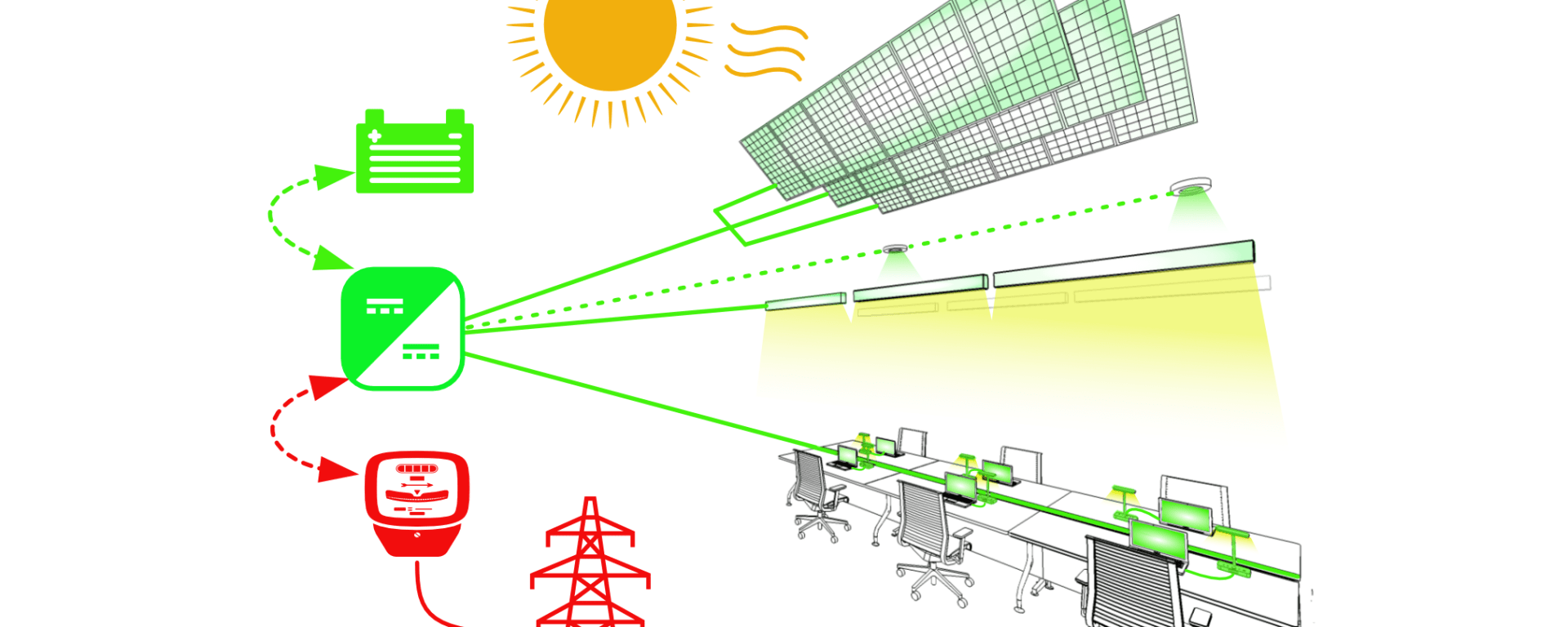
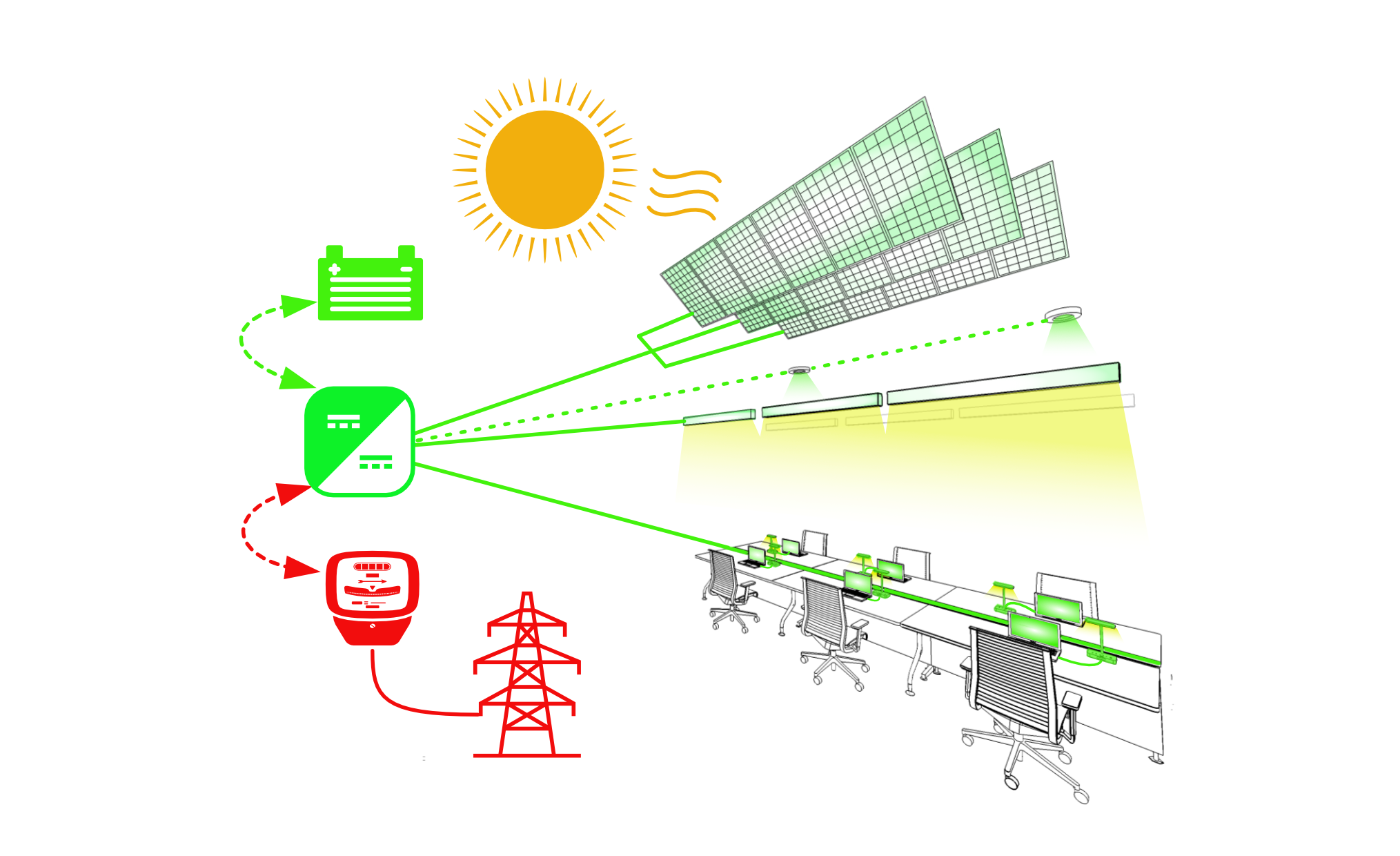
2. The project internally uses a high-efficiency DC-coupled power infrastructure as it’s primary electrical service, fed directly unconverted to DC-powered lighting fixtures. Photons to electrons to photons with no alternating current to be had.
If a building is designed, modelled and constructed to meet those two conditions, it should be given a substantial “bonus” wattage allowance for architectural lighting. I propose at least 2X the wattage per sq/ft allowed by current standards…or by simply eliminating the wattage restrictions entirely for anything that emits light.
Many of you from the engineering side of the biz are probably screaming at the screen right now “BUT why let project teams have so much more installed load capacity????? Isn’t that counter to the goals of a net-zero building????”
No, it isn’t.
I believe discussions about sustainable lighting systems boil down to 2 collective global end goals for humanity:
1. Decarbonize and detoxify so we all don’t die
2. Construct our built environments so that after we don’t die, we can live healthy, positive lives
Notice how neither of the two end-goals for humanity are “LOWER INSTALLED ELECTRICAL LOADS”!
If this is the case, it is clear that most buildings will need to be islands of self-generated clean power, utilizing the most efficient and simple electrical infrastructure (which is clearly DC-power based). If this becomes true, who cares how much installed load the lighting is given? The only thing that matters to a project team is how much power the lighting consumes over time, and with modern digital controls, that will vary wildly across a day, a week, a season and a year. But if the whole project is forcibly held down to ridiculously low installed loads/area, then you’ve clipped all the dynamic range from the lighting system and tied the hands of the design team to the most rudimentary of task lighting.
So who cares?
Actually, the folks fixated on human wellness are going to care a great deal how much power their lighting is using, but in the opposite way most people assume: I believe that healthy circadian lighting will only be achieved in architectural interiors with large volumes of soft light sources spread throughout. And those big, soft lighting features everywhere will take a lot of power, far more than the current ASHRAE 90.1 allows (0.62 w/sqft for offices…because the entire standard is based on dreadfully outdated concepts of lighting design). I think the collective lighting community is going to wake up and realize that soon enough, the IESNA and IALD will have to radically overhaul countless lighting conventions to recognize the fact that we live in the year 2024, not 1984, when most of the lighting application standards originated. Total power consumed across a yearly cycle will become the critical concern, not installed load demands. There will be moments of time when the lighting systems need to draw much more wattage, but these are only temporal.
For example, an office building in a northern climate, on a cold, dark, windy winter morning, will need a lot of wattage to create a pleasant “wake up” scene that actually meets the objectives of melanopic response. This same office may use zero lighting wattage on a summer morning (if lighting codes + lawyers permitted such heresy). But who cares anyway if they have on-site wind turbines feeding battery storage?
And who else cares about having access to unrestricted amounts of clean power?
Folks designing immersive digital experiences. Immersive digital experiences will become key drivers of placemaking across a host of applications. I’ve stated many times: Every light is a pixel and every pixel a light in our modern environment. We must recognize this fact and provide enough clean power for these growing installations that connect our physical world to our digital world.
Let’s look at that same office building example: On that cold, dark morning, large format LED displays might be cranking out gloriously bright scenes and graphics rich in blue light to help everyone wake up and feel vibrant. But in the bright summer months, the screens only show minimal signage graphics across small portions of the screen, using only a fraction of the wattage.
To paraphrase architect William McDonough: We should be designing for abundance, not restrictive zealousness. There is nothing wasteful or indulgent about taking a long, hot shower if the water is heated with solar power and the water is completely recycled.
So counter-intuitively, for the next decade a very simple, no-cost system to incentivize the development and deployment of radically efficient power infrastructure is to remove lighting power consumption restrictions for projects that use DC-coupled, locally generated & stored power. We need to allow and incentivize design teams to incorporate innovative-but-load-hungry new design paradigms into their projects to simultaneously achieve sustainability AND wellness goals.
 Lucept