Check out Core77′s coverage of the Tent Digital show in London. There is a very cool video showing a variety of interactive video and lighting effects.

Check out Core77′s coverage of the Tent Digital show in London. There is a very cool video showing a variety of interactive video and lighting effects.

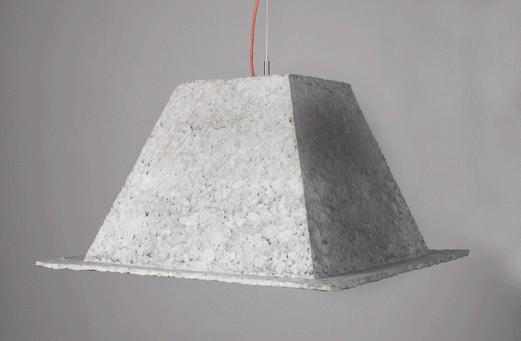
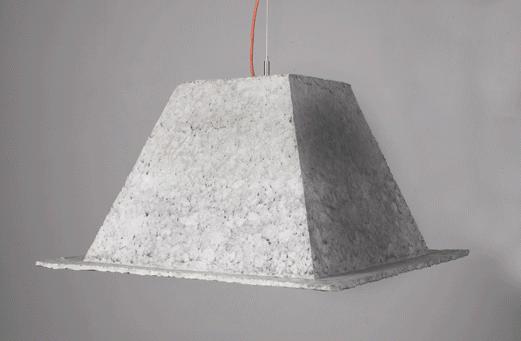
Mark Braun is a Berlin designer who has recently shown a molded pulp-paper lamp shade at several design shows.
I love how it looks like concrete, yet is thin and light enough to be used as a shade. This another great example of sustainable biomass materials in light fixtures.

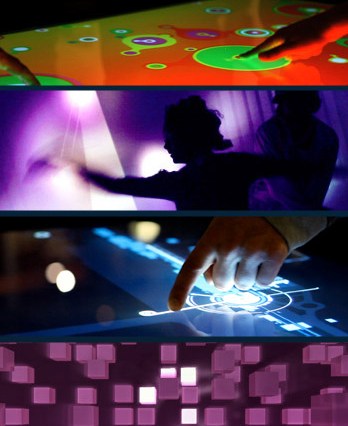
Seeper is a UK-based design firm focusing on multi-touch control installations. You really just have to check out their website and watch the videos…dazzling stuff!
You know you want to: Go ahead, reach out and touch the walls.
Interlam is a Virginia-based fabricator of three-dimensional, cut-to-order wall panels. Using thick sheets of various fiberboard products, they CNC router-cut panels with a variety of patterns of varying depth and relief. It is really amazing the impact one new tool, such as large-format CNC router tables, can have on the abilities of designers to infuse their spaces with new forms of visual richness.
All of these products are complemented nicely with linear grazing light sources, positioned just a few inches off the surface, such as Color Kinetics’ Graze fixture or Focal Point’s Mini-Grazer.

Freedom of Creation is an Amsterdam firm that has explored rapid manufacturing techniques for nearly a decade. FOC launched a series of decorative light fixtures that push the possibilities of the technology: Their pendants, surface mounted fixtures, and table lamps have rich, highly sculptural, biomorphic shapes.

Lumiblade is Philips first major foray into commercial OLED products.
In short, Philips is really just selling sample kits right now for design explorations. The samples are expensive, not very efficient (20 lm/w), and with only 10,000 hours at 50% dimmed output, the lifetime isn’t that great.
However, it is promising to see a technology that has been in development for over a decade finally, even if just tentatively, reach some level of commercial potential.

Howeler Yoon Architecture of Boston has produced several concepts and installations that explore very unique and innovative applications for lighting. Continue reading ‘howeler yoon architecture’
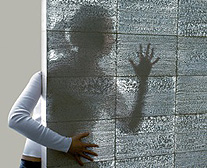
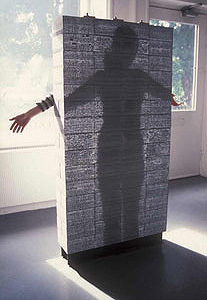
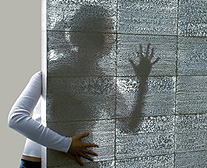
LiTraCon is a combination of optical fibers and concrete. The optical fibers are aligned parallel with each other and perpendicular to the surface, passing the exact light pattern that falls on the outer surface through to the inner surface.

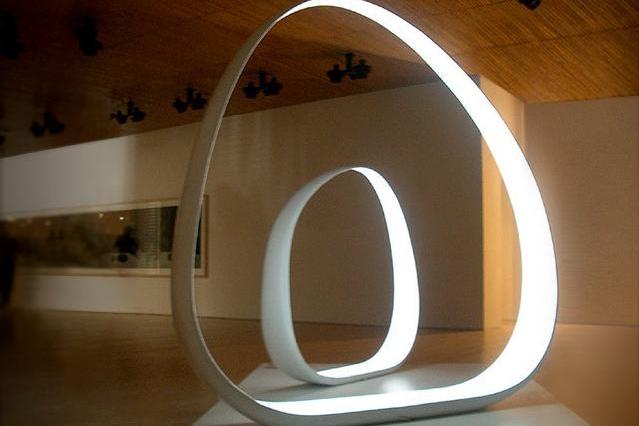
Thin-film light sources have been around for awhile, despite how futuristic they seem to be. Their adoption has been relatively slow for two reasons: First, they have fairly limited light ouput, which restricts them to mostly decorative applications. Second, they are more difficult to implement in architectural designs, usually requiring a lot of custom design. Not that that are difficult to use…they are just not as simple-minded and quick as copying yet another downlight symbol on a reflected ceiling plan. Lifetime varies, depending on how bright they are driven, which is another consideration.
Yet still, the opportunity for creative new explorations of lighting is obvious, such as our previous post on a concept for light emitting wallpaper.

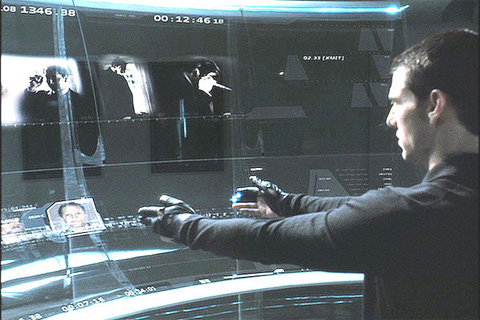
Multi-touch control systems, popularized by Apple’s iPhone, and gesture recognition systems, such as the dazzling computer interface that Tom Cruise used in Minority Report, are slowly-but-surely becoming commonplace technology. And these üeber control technologies are finding their way into architectural applications.
Continue reading ‘large scale, multi-touch interactive displays’